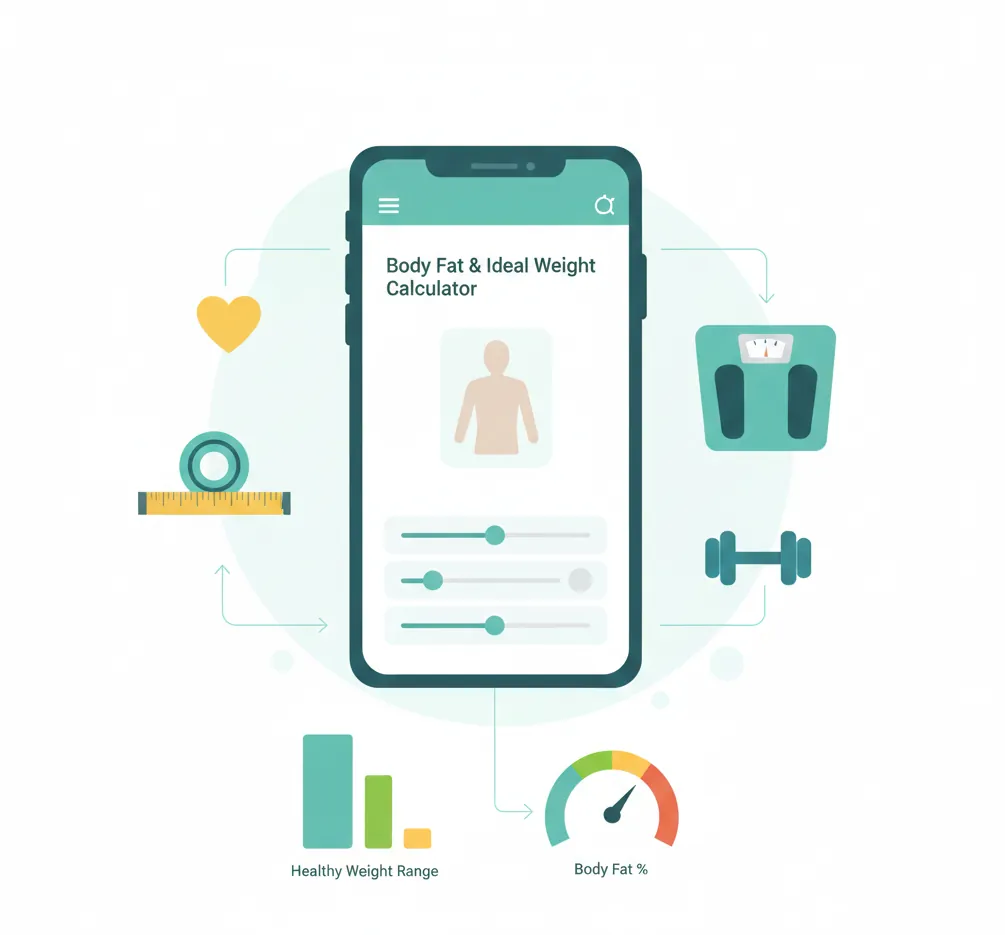
Ideal Weight Is a Range, Not a Moral Score
Scale weight hides composition. Two people can weigh 72 kg and look completely different because muscle, fat, water, and frame size vary. Body fat estimate and ideal weight range help only when they guide better habits, not shame.
A Chennai Sibling Comparison the Scale Could Not Explain
Arjun, 27, from Chennai weighs 78 kg at 170 cm. BMI says overweight, but he has been lifting for four years and has a moderate waist. His sister weighs 58 kg at 160 cm and has a normal BMI but low muscle and high waist-to-height ratio. Their decisions should not be the same.
Why Ideal Weight Can Become the Wrong Target
People chase "ideal weight" without asking what they are losing. Rapid dieting can reduce muscle and make health worse even if the scale goes down.
Another mistake is comparing with celebrity or influencer numbers that ignore height, training history, lighting, and genetics.
Judge Composition, Not Just Kilograms
Use body fat and ideal weight as direction markers. Combine them with waist, strength, stamina, blood markers, and how consistently you can maintain your routine.
If fat loss is the goal, protect muscle with protein and resistance training. If weight gain is the goal, focus on lean mass rather than random high-calorie eating.
What Change Should You Aim For
Choose action based on composition, not scale alone. Reduce fat if waist and body fat are high. Build muscle if weight is low but strength and energy are poor. Maintain if markers are healthy and habits are stable.
Body Metric Tools to Compare
The Final Takeaway
Muscle mass weighs more than fat but drastically improves your metabolic health.
Suggested Action
Shift your focus from losing weight to losing fat by incorporating strength training.
Moving Beyond the Weighing Scale: Why Composition Matters
The weighing scale has one job: to measure gravitational force on your body in a single number. What it cannot do is tell you what that number consists of — how much is muscle, how much is fat, how much is bone, and how much is water. Two people standing on the same scale, reading 70 kg, can have body compositions that place one in excellent health and the other in a risk category. The scale does not know the difference.
Body fat percentage addresses this gap. It expresses what fraction of total body weight is fat mass, as opposed to lean mass (muscle, bone, organ, water). For health and fitness goal-setting, this fraction is more informative than total weight alone, because the health risks associated with excess body fat are driven by the fat specifically — not by weight composed primarily of muscle and bone.
Body Fat Reference Ranges for Indian Adults
Healthy body fat ranges vary by sex and age. Standard reference ranges (adapted for South Asian populations where lower thresholds may apply): For Indian adult men, 10-20% body fat is generally considered fit to acceptable. Above 25% is associated with health risk. For Indian adult women, 18-28% is the fit to acceptable range. Above 33% is associated with health risk. Elite athletes often fall below these lower boundaries — 6-13% for male athletes, 14-20% for female athletes — but these low levels are specific to intensive training states and not target health ranges for general adults.
Research on South Asian populations has found that equivalent health risk occurs at lower body fat percentages than in Western populations — meaning the "acceptable" upper boundaries may in practice need to be lower for Indian adults than the global standards suggest. The practical implication: Indian adults should be more attentive to early increases in body fat rather than waiting to cross high absolute thresholds.
Ideal Weight: A Range, Not a Number
Ideal weight ranges are population-derived estimates of the weight associated with the lowest mortality and disease risk for a given height. They are useful as planning references, not as prescriptions. The Devine formula (one common approach) estimates ideal weight as: Men: 50 kg + 2.3 kg for every inch above 5 feet. Women: 45.5 kg + 2.3 kg for every inch above 5 feet. The B.J. Hamwi method, the Broca formula, and the Metropolitan Life Insurance tables all produce slightly different values.
All of these represent averages derived from statistical populations. They do not account for individual differences in frame size, muscularity, or body proportioning. A person with a naturally heavier skeletal frame may be healthy at a weight above the ideal-weight calculation. A person with high muscle mass from years of resistance training may be healthy at a significantly higher weight than the formula suggests. Use ideal weight as a broad orientation — evidence of roughly appropriate range — not as a precise target that must be achieved.
Practical Applications for Goal-Setting
When used together — current body fat estimate and ideal weight range — these metrics allow more specific goal-setting than weight alone. The key insight is: what kind of weight are you trying to change? If your goal is fat loss, the target is not a specific scale weight but a body fat percentage in the healthy range. Achieving that may mean losing more scale weight than initially expected (if lean mass is low) or less (if significant lean mass exists).
A goal like "I want to lose 10 kg" is less useful than "I want to reduce body fat from 30% to 22% while maintaining lean mass." The latter can be measured more meaningfully over time, informs the choice of training modality (resistance training preserves lean mass during fat loss, cardio alone does not), and produces a different practical program from a generic weight-loss plan.
How Measurement Accuracy Affects the Estimate
Population-formula based body fat estimates using height, weight, and basic measurements carry a margin of error of approximately ±3-5% compared with DEXA scan (the clinical gold standard). This means an estimate showing 28% body fat could reasonably represent anywhere from 23% to 33% actual fat. The estimate is useful for tracking direction over time — is the number trending lower? — rather than treating the specific value as precise.
For maximum consistency in tracking, always measure under the same conditions: same time of day (morning, before eating), same state of hydration, using the same method. This controls for the day-to-day variation in water retention and digestive state that can shift apparent body fat readings by 1-3% without any real composition change.
This content is for general health information. Body composition estimates are screening references, not clinical measurements. Consult a healthcare professional or registered dietitian for personalized health and fitness guidance. Not medical advice.