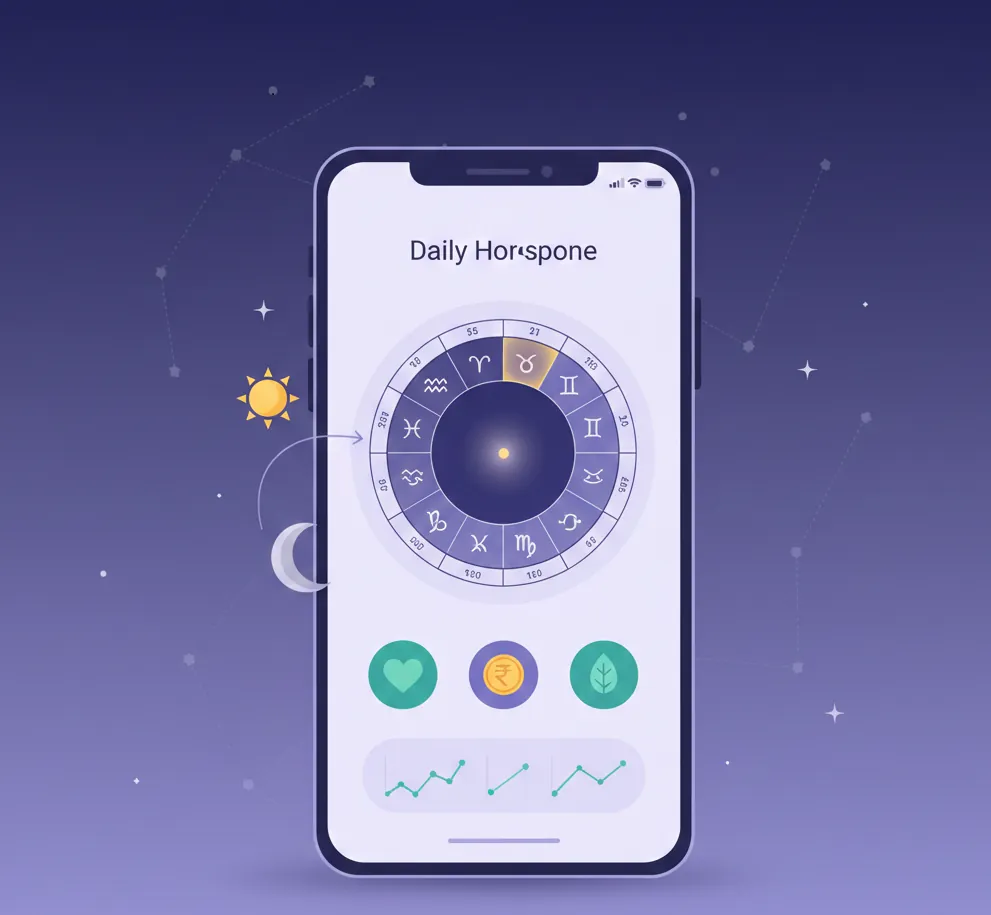
A Horoscope Is Better as Reflection Than Prediction
Daily horoscopes are popular because they give a small moment of direction. In India, many people read them with morning tea, before work, or around festivals. The healthiest way to use them is reflective: what should I pay attention to today?
A Kolkata Workday Reading Used Sensibly
A sales manager in Kolkata reads a horoscope warning about communication. Instead of cancelling meetings, she uses it as a reminder to prepare better, avoid sharp replies, and follow up clearly. The value comes from behaviour, not prediction.
When a Horoscope Takes Too Much Control
Some people outsource decisions to a daily paragraph. They delay calls, investments, travel, or apologies because a horoscope sounded negative.
Others dismiss the entire practice but still miss the useful reflective habit: pausing before the day begins.
Turn the Reading Into a Prompt
Read horoscope content as a journaling prompt. If it mentions money, review spending. If it mentions relationships, check tone and patience. If it mentions health, take a walk or sleep on time.
Keep agency with yourself. A horoscope should make you more attentive, not less responsible.
How Much Weight to Give Today’s Message
Use daily horoscope for mood, reflection, and cultural connection. Do not use it to make financial, medical, legal, or relationship decisions without real evidence and conversation.
Daily Reflection Tools
The Final Takeaway
Daily readings are prompts for self-reflection, not inevitable realities.
Suggested Action
Use today's guidance to prepare mentally for challenges rather than expecting them.
Daily Horoscopes in Indian Life: Entertainment, Ritual, or Something In Between?
Daily horoscopes occupy a unique cultural space in India. They appear in every major newspaper — Hindi, English, and regional language alike. They generate millions of searches daily. They are read over morning chai, checked on phones before important meetings, and shared in family WhatsApp groups with commentary ranging from enthusiastic agreement to affectionate skepticism. They serve simultaneously as entertainment, cultural ritual, and for some readers, a genuine reflective practice.
The range of engagement with horoscopes in India is itself culturally interesting: a software engineer in Bengaluru may read their daily Scorpio prediction "just for fun" while a grandmother in Jaipur may plan her day around the panchanga's guidance with complete sincerity. Both uses are valid within their own framing — the problem arises only when entertainment content is treated as reliable life-guidance or when cultural tradition becomes pressure to follow predictions that don't align with practical judgment.
How Daily Horoscopes Are Written
Understanding how horoscope content is produced is useful context for reading it with appropriate expectations. Most commercial daily horoscopes are written by astrologers who track major planetary positions — primarily the moon's daily transit through the zodiac, the slow movements of outer planets, and the interplay of these against a considered sun sign or moon sign framework. The resulting text describes themes associated with current planetary positions relevant to each sign.
The inherent limitation is reach: a single Virgo prediction is read by roughly 1/12 of the population — over 100 million people in India alone. These individuals have vastly different charts, life circumstances, and daily situations. Any statement true for all of them simultaneously must be broadly framed. This breadth is why horoscope content tends toward universally applicable themes — "communication may require extra care today," "financial matters deserve attention this week" — rather than specific, verifiable predictions.
The Psychological Function of Daily Horoscopes
Decades of psychological research on horoscope reading suggest that the primary mechanism through which daily horoscopes produce value for readers is not predictive accuracy (which research consistently fails to find above chance) but the attention-directing function. A horoscope that says "focus on relationships today" prompts the reader to actually attend to their relationships that day — not because the planets mandated it, but because the prompt activated deliberate attention. The improvement in the relationship comes from the human being, not the celestial configuration.
This attention-directing function is not trivial. In the scroll-rapid pace of modern life, prompts that encourage reflective focus — on patience, on communication, on financial care, on self-care — can be genuinely useful. The honest version of this is: the value of a good daily horoscope is not its predictive power but its capacity to act as a daily intention-setting prompt. Used that way, it supplements mindful living rather than becoming a substitute for judgment.
Rashi-Based Horoscopes vs Sun Sign Horoscopes
In the Indian context, many astrological publications offer both English-language sun-sign horoscopes (familiar to Western audiences) and rashi-based predictions (using Vedic moon signs). These often carry different content because they are using different frameworks: the Western reading tracks solar transits against tropical sun signs, while the Vedic reading tracks lunar transits and planetary positions against the sidereal moon sign.
For someone whose Vedic rashi (moon sign) is different from their Western sun sign — which is the case for approximately 70% of people due to the ayanamsha divergence between the two systems — reading both may produce different thematic content for the same day. Neither is definitively "correct" — they are different traditional lenses applied to different astrological references. Some astrology-engaged people read both and notice which resonates more clearly.
What to Take from a Daily Horoscope and What to Leave
Take: thematic prompts that feel relevant to your actual life situation today. If the reading mentions caution in financial decisions and you genuinely have a financial decision pending, using that as a prompt for extra diligence is healthy. The planet placement did not mandate the caution — your pending decision did. The horoscope simply activated your attention to it.
Leave: specific predictions about named events, external warnings that create anxiety without any actionable guidance, and any reading that seems to demand behavior change based on celestial timing rather than your own values and practical assessment. A horoscope that functions as an anxiety generator or an authority that overrides your judgment has moved beyond its appropriate role.
Horoscope content is interpretive and entertainment-oriented. Planetary positions do not determine individual daily outcomes. Significant decisions should be guided by evidence, professional advice, and personal judgment. This is not predictive guidance.