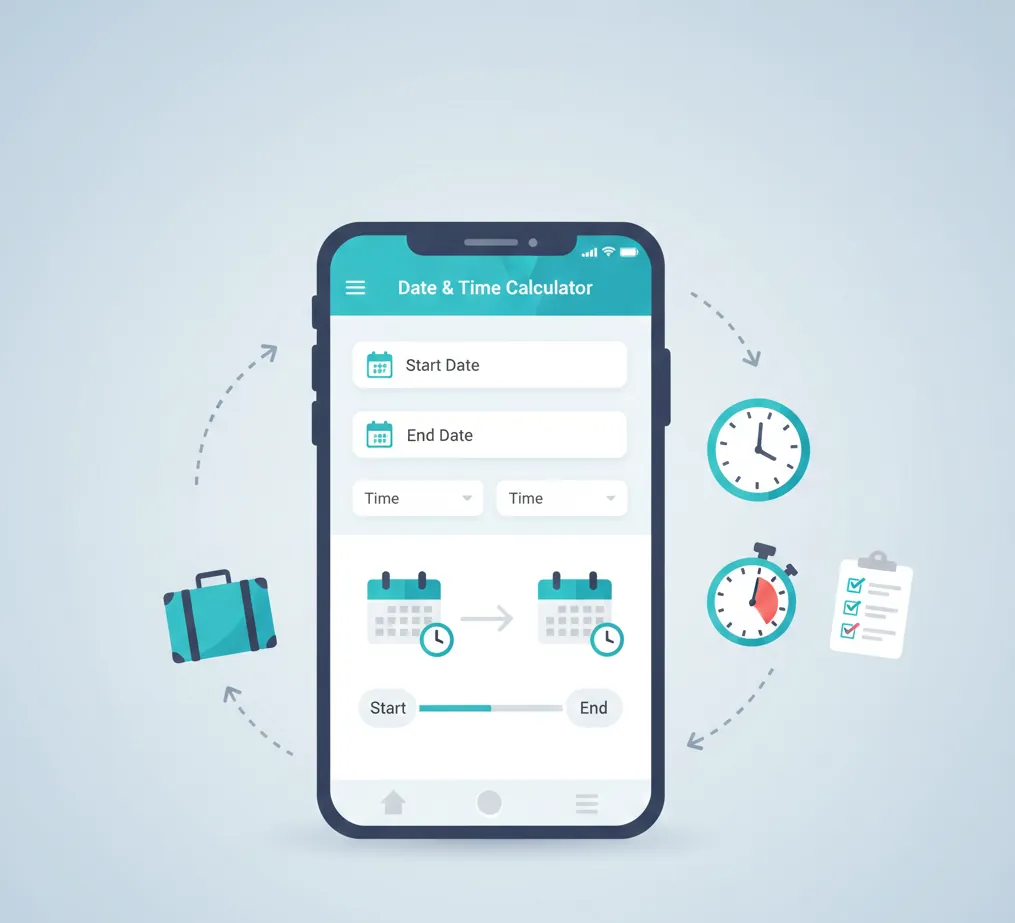
Date Gaps Are Easy to Miscount Manually
Date and time calculations become important in notice periods, rent agreements, project timelines, billing cycles, travel plans, and legal deadlines. Counting days on a calendar feels simple until weekends, start dates, end dates, and months with different lengths get involved.
A Bengaluru Notice Period Counted Two Ways
A software employee in Bengaluru resigns on April 18 with a 60-day notice period. HR and the employee initially disagree on the last working day because one side includes the resignation date and the other starts counting from the next day. A precise date calculation helps them discuss the policy clearly.
The Counting Rule People Forget
People count both start and end date without checking the rule. For invoices, legal notices, and employment policies, inclusion matters.
Another mistake is ignoring time across midnight. A shift from 10 pm to 6 am is 8 hours, not a negative number.
Read the Policy Before Counting Days
First read the policy or agreement. Does it say from date of notice, after date of notice, calendar days, working days, or business days? Then calculate.
For professional communication, write the start date, end date, and total duration clearly to avoid later disagreement.
How to Confirm the Deadline
Use a date-time calculator whenever money, employment, rent, or deadlines depend on the result. For legal or official deadlines, confirm the counting rule from the source document.
Time Planning Tools
The Final Takeaway
Manual day counting frequently leads to missed deadlines and compliance errors.
Suggested Action
Use precise calendar math before signing contracts that stipulate exact notice periods.
Date Arithmetic in Professional and Personal Life
The date calculator solves a deceptively simple problem: "how many days between these two dates?" This question appears in professional contracts, project timelines, loan notice periods, subscription billing, warranty expiry verification, academic leave tracking, tax deadlines, and dozens of personal situations. The gap between two dates is simple to articulate and consistently prone to mental arithmetic error when months of different lengths are involved.
Manually counting from March 15 to July 3 requires remembering that March has 31 days (so 16 days remain in March), April has 30, May has 31, June has 30, and then 3 days into July — and this is before any year-boundary or leap-year complication enters. The calculation takes 30 seconds but introduces opportunities for off-by-one errors that, in contract contexts, can mean a legally relevant difference of one day.
Employment Notice Periods: A Major Practical Use Case
Notice period calculation is one of the most frequently mishandled date arithmetic situations in Indian professional life. A contract specifying a 60-day notice period requires knowing: does the count begin on the day of resignation or the day after? Is the last day of notice the 60th day counted from the resignation, or the first day of the 61st day beyond it? Do weekends and public holidays count in notice day calculation (for most Indian contracts, they do — notice is calendar days, not working days, unless the contract specifically says otherwise)?
From the HR perspective, getting notice period dates wrong creates payroll complications, full-and-final settlement delays, and occasionally legal disputes. From the employee perspective, leaving one day before the full notice period completes can result in recovery of pay or loss of relieving letter. A calculator that gives the precise date — "if I resign on April 13 with a 90-calendar-day notice, my release date is July 12" — is genuinely valuable to both parties.
Project Management and Deadline Tracking
In project timelines, the difference between a working-days count and a calendar-days count is critical. If a client specifies "deliverable in 15 business days from kickoff on June 2," the actual deadline is not June 17 — it is June 23, assuming 3 weekends (6 days) within the window and no public holidays. A date-differences calculator that handles both calendar-day and working-day modes makes planning-level conversation more reliable.
For project managers handling multiple concurrent streams, date difference calculation also supports backward planning: if the final delivery is due September 30 and there are 4 development phases each requiring 2 weeks, 1 week of UAT, and 1 week of buffer, the start date needs to be no later than July 26 to make that deadline. Calculating these chains manually across a complex project timeline creates compounding error risk. The calculator handles each discrete gap precisely.
Financial Applications: EMI Dates, Billing Cycles, and Deadlines
EMI due dates and billing cycles are another area where precise date calculation matters. Most home loans in India have EMI due dates on the 1st or 5th of each month, counted from the date of first disbursement. Calculating whether a partial prepayment changes the EMI cycle, when a specific anniversary prepayment window opens, or how many remaining EMIs exist from a given date — these are useful applications of a date-difference tool in loan management.
Tax deadline planning is a major application for self-employed professionals and HUFs. Advance tax installment due dates (June 15, September 15, December 15, March 15), GST filing deadlines (typically 20th of the following month for GSTR-3B), TDS deposit deadlines, and ITR filing dates all require date-aware planning. Calculating how many days remain before a specific tax deadline — and working backward to identify the documentation and preparation timeline — is a practical use of the date calculator for tax-disciplined businesses.
Personal Applications: Anniversaries, Countdowns, and Life Milestones
Beyond professional use, date calculators see wide personal use for emotionally meaningful applications: how many days have passed since a wedding, how many days until a baby's first birthday, how long a loved one served in the military, how many days of sobriety have been maintained. These personal counting applications give moments of significance a concrete numerical anchor that can be meaningful far beyond their arithmetic content.
Anniversary and milestone calculations are also increasingly used in digital context — anniversary posts that specify "X days of marriage" or "X days since launch" require date arithmetic that most people cannot quickly do in their heads for anything beyond simple year counts. The calculator provides the specific number that makes these communications more interesting and precise.
Time Calculations: When Hours Matter
For same-day or multi-day time calculations — shift length, travel duration, exam session duration, online auction closing time — the time component of the date calculator becomes relevant. Most commonly, this means calculating the duration between two timestamps on the same or adjacent days: "my flight departs at 6:15 PM and arrives at 2:40 AM the next day — how long is the flight?" or "my shift starts at 10 PM and ends at 6 AM — how many hours is that?"
Time zone differences, particularly relevant for remote workers, international business, and NRI personal connections, require conversion to a common time zone before the duration calculation is meaningful. The calculator works within a single time reference — both times should be converted to the same zone before entering if they originate in different zones.