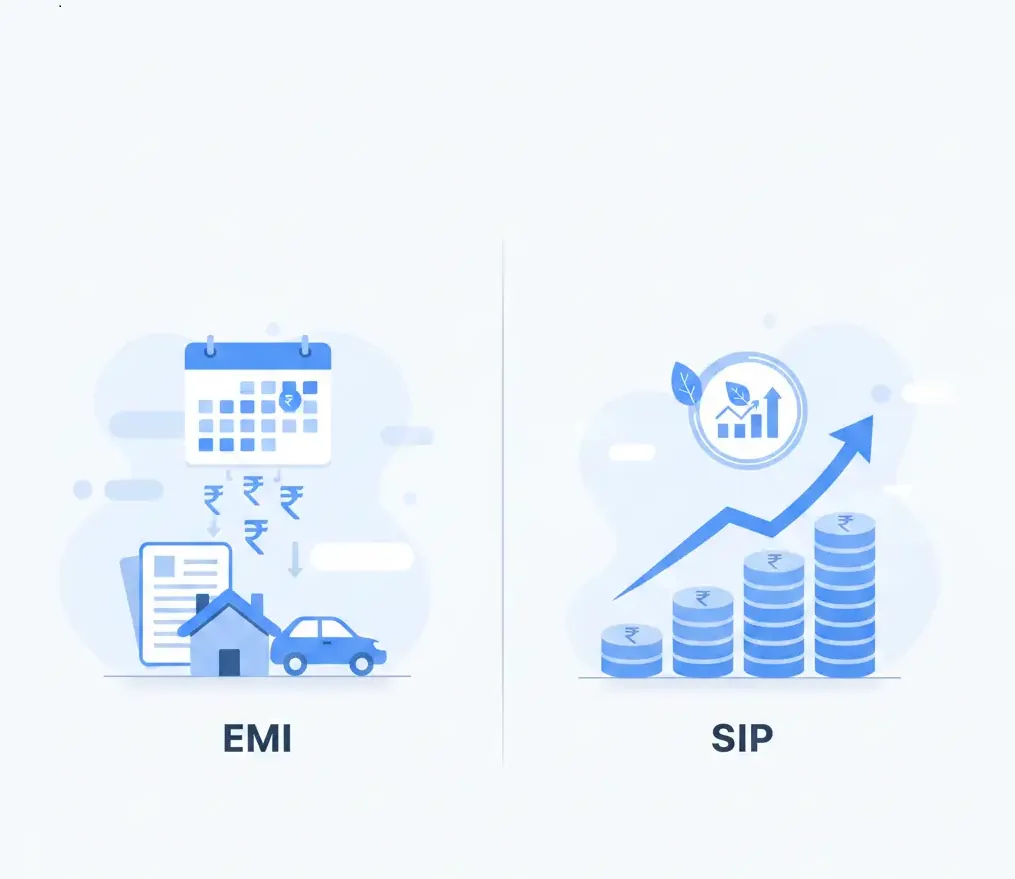
EMI vs SIP Is Really a Monthly Decision
The EMI vs SIP question is not academic. It shows up on salary day when rent, home loan EMI, credit card bill, school fees, parents' medicines, and mutual fund SIPs all compete for the same bank balance. The wrong answer is usually not visible immediately. It appears years later as either heavy debt with no savings, or investments that had to be stopped because the loan load became too tight.
A good decision does not say "always repay loan first" or "always invest first." It asks what kind of loan you have, what interest rate you are paying, whether your job income is stable, and whether you already have an emergency fund.
A Pune Salary-Day Example
Rohit from Pune takes home Rs 92,000 per month. He has a home loan EMI of Rs 34,000, a car EMI of Rs 12,500, and a SIP of Rs 15,000. A bank offers him a Rs 4 lakh personal loan for home interiors at 16%. On paper, the EMI is only around Rs 14,000. In real life, that would push his total EMIs above Rs 60,000 and force him to stop the SIP after one or two months.
The decision is not "Can he get the loan?" The decision is "Will this loan destroy his investment discipline?" In his case, delaying interiors for six months and using savings plus a smaller loan is better than adding one more full EMI.
Where EMI Planning Usually Goes Off Track
Many people compare EMI and SIP as if both are optional. They are not. EMI is a legal obligation. SIP is a future-building habit. Because the EMI has immediate consequences, people allow it to eat the SIP first. That is how years of compounding quietly disappear.
The second mistake is ignoring interest rate. Paying down a 19% credit card balance is usually smarter than investing more in equity funds, because the debt cost is certain and high. But prepaying a 8.5% home loan aggressively while stopping every SIP may not be wise if retirement or education goals are underfunded.
A Cleaner Way to Split Debt and Investing
Separate your loans into high-cost, medium-cost, and asset-backed debt. Credit cards and expensive personal loans should be cleared before increasing SIPs. Home loans can usually run alongside SIPs if the EMI fits the budget and you maintain a cash reserve. Car loans sit in the middle: keep them short, avoid upgrades, and do not sacrifice long-term SIPs for a model jump.
Use a salary rule that is simple enough to follow: total EMIs below 40% of take-home, minimum SIP protected every month, and at least three months of expenses in liquid savings. After that, salary hikes can be split between SIP increases and selective loan prepayment.
The Call to Make This Month
Choose prepayment first when the loan rate is above 14%, the EMI is making you dip into savings, or the debt funded consumption. Choose SIP continuation when the loan is manageable, the rate is reasonable, and your goal has a long time horizon. Choose both when you receive a bonus: put one part toward principal reduction and one part toward investments.
The practical answer is this: protect your SIP like an EMI, but attack expensive debt like a financial emergency.
Calculators for the Same Decision
- EMI Calculator - test the loan burden first
- SIP Calculator - see the cost of delaying investments
- Salary Calculator - check true monthly capacity
The Final Takeaway
Balancing debt and wealth building requires knowing your exact cash flow.
Suggested Action
Start by tracking your monthly EMI outgo versus your investment contributions this week.
The Monthly Cash Flow Question Every Indian Salaried Person Faces
Every month, millions of working Indians look at their bank accounts after salary credit and face the same calculation: what goes out in obligations, what goes toward goals, and what genuinely remains for daily life. EMIs and SIPs compete for the same limited pool of discretionary income — and most people manage this tension by instinct rather than design.
That instinct is often expensive. Prioritizing all EMIs and skipping SIPs for years costs compounding time that cannot be recovered. Prioritizing SIPs while taking on more EMI debt than the budget can absorb creates financial stress, loan default risks, and interrupted SIPs anyway. A clear framework for thinking about this trade-off is worth the effort to understand once and apply continuously.
What EMI and SIP Actually Represent in Budget Logic
An EMI is a contractual outflow. It exists because you borrowed money and agreed to repay it at a fixed monthly amount. Missing an EMI damages your credit score, invites late-payment charges, and — depending on the loan type — triggers legal recovery processes. EMIs have no flexibility; they are obligations.
A SIP is a voluntary investment instruction. If you skip a month, nobody calls you. The mutual fund simply does not draw funds that cycle. The long-term cost of skipped SIPs is real but invisible in the short term — lost compounding, a smaller corpus at the end of the investment horizon. Unlike an EMI, a SIP missed today does not carry a penalty, but it does carry an opportunity cost that compounds over time.
This difference — obligation versus voluntary — explains why SIPs tend to lose in budget prioritization when cash flow is tight. The EMI threatens immediate consequences. The SIP only threatens future consequences. Financially disciplined households treat SIP as an obligation equal in practical urgency to EMI, because they understand that violated future consequences are just as real — they simply arrive later.
The Real Cost of Skipping SIPs for EMI
A concrete example clarifies the trade-off. Suppose you start a Rs 10,000 monthly SIP at age 28 for equity mutual funds targeting 11% annual return. If you continue for 22 years until age 50, the estimated corpus is approximately Rs 92 lakh on total investment of Rs 26.4 lakh.
Now suppose you took a car loan at 28 and paused the SIP for 4 years to accommodate the Rs 10,000 EMI. You restarted the SIP at 32 and ran it until 50 — 18 years instead of 22. The estimated corpus drops to approximately Rs 65 lakh. You lost Rs 27 lakh of corpus — more than the entire car loan cost — simply because the 4 earliest years of compounding were sacrificed. Compounding's exponential nature means the first years contribute the most to the final corpus.
The Right Order of Financial Priorities
A practical prioritization framework for managing EMI and SIP together looks like this:
First: Fund a 3-month emergency reserve before taking on any new debt or starting a new SIP goal. This reserve protects both your EMIs and your investment continuity when income interruptions or unexpected expenses occur.
Second: Pay off any existing high-interest unsecured debt — credit card outstanding, personal loans above 14% — before allocating aggressively to SIPs. The post-tax return on eliminating 18% credit card debt is effectively 18%. No mutual fund guarantees that consistently.
Third: Start and protect at least one SIP even if small. Rs 2,000 per month in a balanced or index fund is far more valuable than waiting for the "perfect" amount. Discipline and time in the market matter more than the size of the initial contribution.
Fourth: Constrain new EMIs so that total EMI-to-take-home ratio stays below 40-45%. Beyond this level, the household has limited ability to absorb income shocks, and forced SIP suspension becomes likely.
When Taking an EMI to Fund an Asset Is Rational
Not all EMI-based borrowing is financially suboptimal. A home loan for a primary residence is often the correct financial choice even if it displaces some SIP capacity, because the alternative — paying rent while having no asset appreciation — has its own opportunity cost. The key is that the home is an appreciating asset being purchased at the cost of interest, which is a potentially rational exchange.
A car loan for a vehicle that directly enables income (a professional who needs transportation for work, a small business owner who depends on the vehicle operationally) can also be rational even if it affects SIP capacity temporarily. The threshold question is whether the debt funds an asset with productive value or funds only consumption. Consumption debt — personal loans for vacations, gadget upgrades on credit, lifestyle purchases at EMI — have no asset on the other side of the ledger.
Practical Balance Strategies for Middle-Income Indian Households
For a salaried person with a take-home of Rs 70,000 per month managing both EMIs and SIPs, a reasonable allocation pattern might look like this: Rs 28,000 in EMIs (40%), Rs 10,000 in SIPs (14%), Rs 15,000 in rent or fixed housing cost, Rs 7,000 in household emergency/savings, and Rs 10,000 in variable living expenses. This leaves Rs 0 of formal discretionary buffer — which means any increment from salary should go first to the emergency fund top-up and then to increasing SIP before lifestyle inflation.
When an increment arrives — say Rs 8,000 more per month after tax — the temptation is to upgrade lifestyle or relax spending. The financially effective move is to increase SIP by Rs 5,000 (since the EMI schedule is already covered) and let Rs 3,000 add flexibility. This "increment-to-SIP" habit is one of the most consistently wealth-building patterns among middle-class Indian families who have accumulated significant corpus by retirement.
What Each Calculator Reveals That the Other Cannot
Use the EMI calculator to understand your obligation landscape. Every loan you hold produces a monthly deduction from discretionary income. Seeing all EMIs together — home loan, car loan, education loan — and their total against your income reveals your current financial flexibility margin. That margin is what funds SIPs, emergencies, and life's variable costs.
Use the SIP calculator to understand the cost of delay. Enter the amount you would invest if you had no new EMI and calculate the 15-year corpus. Then enter the amount left after the EMI and compare. The corpus difference represents the real cost of the EMI in wealth-creation terms — which is never visible in the EMI number alone.
Running both calculations together, for a real financial decision — a car purchase, a flat upgrade, a home renovation loan — takes 10 minutes and produces information that is genuinely worth having before signing.
Interpreting the Results Together
The balanced conclusion from this analysis is not that EMIs are bad. It is that every new EMI has a real wealth cost that should be made visible before the commitment is made, and that SIPs should be treated as non-negotiable obligations rather than optional contributions that survive only when budgets are comfortable. The households that build meaningful wealth on Indian middle-class salaries generally share one characteristic: they protect their SIPs with the same discipline they apply to their EMI payments.
This content is for financial planning and educational purposes. Not a substitute for personalised professional financial advice. Mutual fund SIP returns are market-linked and subject to volatility — past performance does not guarantee future results.
Tools for Balancing Debt and Investing
- SIP Calculator — project long-term wealth from monthly investments
- Home Loan EMI Calculator — plan housing loan EMI and total interest
- Salary Calculator — understand your real take-home before planning
The Final Takeaway
Balancing debt and wealth building requires knowing your exact cash flow.
Suggested Action
Start by tracking your monthly EMI outgo versus your investment contributions this week.