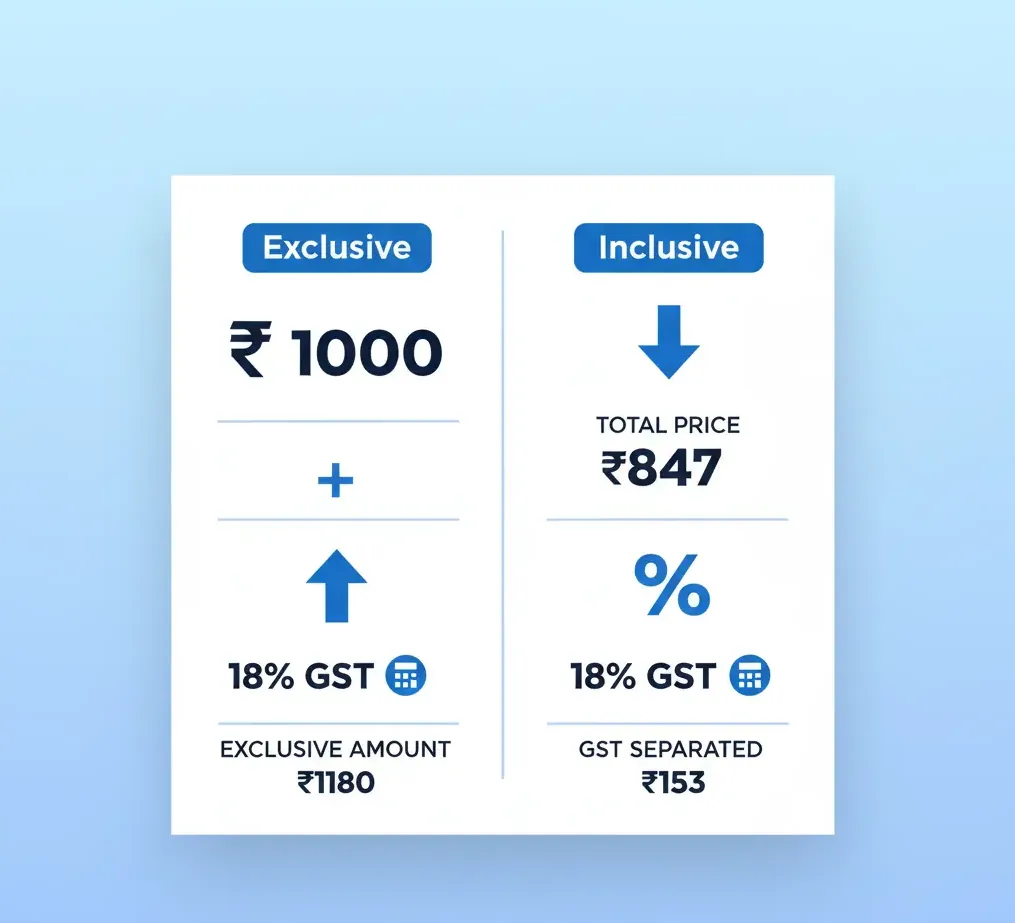
GST Is Not Just a Percentage on a Bill
GST looks simple when someone says 18%. The confusion starts when a shopkeeper says "GST extra", a freelancer quotes an inclusive price, or a small business owner has to split CGST and SGST correctly on an invoice. For many Indian users, the real question is not the formula. It is whether the price being discussed already includes tax.
A Freelance Invoice That Became Awkward
A freelance designer in Nagpur quotes Rs 50,000 for a branding project. The client assumes the amount includes GST. The designer assumes GST will be added later. When the invoice is raised at Rs 59,000 with 18% GST, the client pushes back. If the designer absorbs the tax, their actual service value drops to Rs 42,372 plus GST instead of Rs 50,000 plus GST.
The money conflict came from one missing phrase: "exclusive of GST" or "inclusive of GST."
The Pricing Error Hidden in GST Quotes
People calculate GST correctly but apply it to the wrong base. If Rs 1,180 is GST-inclusive at 18%, the GST is not Rs 212.40. The taxable value is Rs 1,000 and GST is Rs 180. Inclusive pricing requires reverse calculation.
Small businesses also forget that intra-state invoices split GST into CGST and SGST, while inter-state invoices use IGST. The customer may pay the same total, but invoice treatment changes.
Make Tax Treatment Clear Before Work Starts
Before calculating, decide the pricing direction. If tax is extra, calculate GST on the base amount. If the price is final, remove GST from the total to find taxable value. Put the phrase clearly in quotations, WhatsApp approvals, purchase orders, and invoices.
For business use, keep a small checklist: GSTIN, place of supply, tax rate, taxable value, CGST/SGST or IGST, and final amount. That habit prevents most invoice disputes.
How to Quote or Check the Bill
If you are a customer, ask whether the quote is inclusive before accepting. If you are a seller, mention the tax treatment before work begins. If the amount is for accounting, do not round casually. A small GST mistake repeated across many invoices becomes a real compliance problem.
Billing Tools Worth Keeping Nearby
The Final Takeaway
Small GST errors compound into major compliance issues over a financial year.
Suggested Action
Always separate your base price from the tax component before finalizing any quote.
What GST Actually Is and Why Every Indian Consumer Encounters It Daily
Goods and Services Tax replaced a fragmented multi-layer tax system in India in July 2017 and transformed how every commercial transaction is priced, recorded, and paid. The GST number on your restaurant bill, the 18% on your mobile recharge, the 12% embedded in the medicine you buy at a pharmacy — all of these follow a set of rules that, once understood, make pricing in India far more transparent than the pre-GST era of hidden excise duties and cascading taxes.
Despite its ubiquity, most Indian consumers and small business owners are not entirely clear on how GST is calculated, what inclusive versus exclusive means, or when GST applies to them directly versus merely passing through their transaction. This guide clarifies the mechanics with specific, practical examples relevant to everyday Indian life and commerce.
The GST Slab Structure in India
India's GST operates across five main tax rates, each applying to specific categories of goods and services:
0% (Nil rate): Essential food items — fresh vegetables, rice, wheat, milk, eggs, and a range of unbranded staples — are exempt. Basic health services, educational services, and a few other categories are also zero-rated. You encounter Nil GST most often at local kirana stores and at unlicensed vendors selling unpackaged goods.
5%: Packaged food items, economy class airline tickets, some healthcare goods, restaurants within starred hotels, and certain services. Most packaged biscuits, sweets, and edible commodity items fall here.
12%: Processed food, mobile phones (now some at 18%), computers, business-class air travel, certain clothing above a threshold price, and many capital goods.
18%: This is by far the most common slab for services. Software services, IT, financial services, professional services (legal, consulting, marketing), restaurant services (non-composition dealer), most hotel accommodation, and a wide range of manufactured goods. Most bills you encounter in urban daily life for professional services carry 18% GST.
28%: Luxury and "sin" goods — luxury cars, tobacco products, cement, large household appliances, aerated drinks. This slab often carries an additional cess on top of 28%.
Exclusive vs Inclusive GST: The Most Common Source of Confusion
When someone quotes you a price, they may mean one of two things: the price before tax (exclusive) or the price including tax (inclusive). Understanding which one is being quoted is essential for calculating the correct payment and for issuing correct invoices.
Exclusive GST: The quoted amount is the base price. GST is added on top. Formula: Final amount = Base amount × (1 + GST rate/100). Example: A freelance project is quoted at Rs 50,000 exclusive of GST at 18%. The client pays Rs 50,000 + Rs 9,000 = Rs 59,000. The invoice shows base Rs 50,000, CGST Rs 4,500, SGST Rs 4,500, total Rs 59,000.
Inclusive GST: The quoted amount already includes GST. To find the base and the tax component, you need to work backward. Formula: Base amount = Total amount / (1 + GST rate/100). GST amount = Total amount - Base amount. Example: A restaurant bill is Rs 590 with 18% GST included. Base amount = Rs 590 / 1.18 = Rs 500. GST = Rs 90. The restaurant collected Rs 500 as revenue and Rs 90 as GST liability.
The reverse calculation (extracting GST from an inclusive amount) is where most manual errors happen. People mistakenly subtract 18% of the total amount: 18% of Rs 590 = Rs 106.20. This is wrong — it inflates the GST figure. The correct method divides by 1.18, not subtracts 18%.
CGST, SGST, and IGST: What the Split Means on Your Invoice
GST in India is split between the central and state governments for most transactions. For intra-state transactions (buyer and seller in the same state), the full GST is split equally between CGST (Central GST) and SGST (State GST). For inter-state transactions (seller in one state, buyer in another), IGST (Integrated GST) applies at the full rate and is collected by the central government, which then distributes the state's share.
Practical impact: if you are a Delhi-based freelancer billing a Delhi-based client at 18%, the invoice shows CGST 9% and SGST 9%. If your client is in Mumbai, the invoice shows IGST 18%. The total GST amount is the same in both cases — only the split changes. This has no effect on the client's total payment but matters for the seller's compliance filing.
When You Are a Consumer vs When GST Is Your Liability
For most consumers, GST is a cost embedded in the price of goods and services. You pay it, but you have no GST filing obligation. The retailer, service provider, or e-commerce platform collects it and remits it to the government.
Your relationship with GST changes materially when you start a business, provide freelance services professionally, or run an enterprise with annual turnover exceeding Rs 20 lakh (Rs 10 lakh in some states). At that point, you are required to register for GST, collect GST from clients, maintain records, and file monthly or quarterly returns depending on your category.
However, professional freelancers whose annual income from services exceeds Rs 20 lakh are required to register for GST. If you are a freelance designer, developer, consultant, content creator, or other service professional above this threshold, you must charge GST on invoices and file returns. Ignoring this requirement creates legal and financial compliance risk.
Input Tax Credit: Why GST Is Not Simply a Cost for Registered Businesses
One of the significant improvements GST brought over the older tax system is the Input Tax Credit (ITC) mechanism. Registered businesses that pay GST on purchases used for business purposes can claim those payments as a credit against their GST liability on sales. This means GST does not cascade — you pay the net amount of output tax minus input credit.
Example: A manufacturing company pays Rs 18,000 in GST on raw material purchases (input GST). It then collects Rs 36,000 in GST from customers on finished-goods sales (output GST). Its net GST liability is Rs 36,000 - Rs 18,000 = Rs 18,000, which it remits to the government. Without ITC, it would pay the full Rs 36,000 despite already having paid Rs 18,000 on inputs — exactly the cascading tax problem GST was designed to eliminate.
For consumers, ITC does not apply — you pay GST and cannot claim it back. For businesses, understanding which purchases qualify for ITC (those used for business purposes on which a valid tax invoice is held) and which are blocked (certain personal-use categories, motor vehicles in most cases, food and beverages) is a core part of GST compliance.
Common GST Mistakes on Indian Invoices
The most frequently seen error on small-business and freelancer invoices is applying GST on an already-inclusive amount. If a service was agreed at "Rs 1,18,000 all inclusive," collecting 18% GST on top produces a double-tax situation and is incorrect. The correct approach is to confirm whether the agreed amount was inclusive or exclusive before issuing the invoice.
A second common mistake is using the wrong GST slab. Applying 18% to a service that should be 12%, or 28% to a product that attracts 18%, creates incorrect invoicing that must be corrected through credit notes and can cause compliance issues for both parties.
Third: generating invoices without a proper GSTIN, invoice number sequence, date, and HSN/SAC code. All of these are mandatory fields on a GST-compliant tax invoice. An invoice missing these fields makes the buyer's ITC claim legally risky and may be rejected in a GST audit.
How to Use the GST Calculator Effectively
The GST calculator on this site handles both the forward calculation (adding GST to a base price) and the reverse calculation (extracting GST from an inclusive amount). Select the mode that matches your situation first — this is the most important step. Then enter the base amount and select the applicable slab.
For invoice verification, use the inclusive (reverse) mode when you receive a bill that shows only a total and want to confirm the tax component. For quoting clients or pricing products, use the exclusive (forward) mode to calculate the final customer-facing price. The CGST/SGST split shown applies to intra-state transactions — for inter-state, the full rate appears as IGST.
This content is for informational purposes regarding GST mechanics. Tax classification of specific goods and services, ITC eligibility, and filing compliance requirements should be verified with a registered GST practitioner or chartered accountant. GST rules are subject to periodic updates by the GST Council.
Billing Calculators for the Next Step
- Salary Calculator — understand income tax alongside GST obligations
- Percentage Calculator — fast ratio and proportion calculations
The Final Takeaway
Small GST errors compound into major compliance issues over a financial year.
Suggested Action
Always separate your base price from the tax component before finalizing any quote.