Numerology Is Useful When It Sparks Self-Reflection
Life path numbers are popular because people enjoy patterns that describe personality and direction. The key is to use numerology as a mirror, not a cage. A number can suggest themes; it should not limit choices.
A Vadodara Student Turned a Number Into Action
Dev, a college student in Vadodara, calculates a life path number and reads that it suggests leadership. Instead of assuming destiny will handle his career, he joins a student committee and tests whether leadership feels natural in practice.
The Problem With Treating Numerology as Fate
People turn a number into a verdict. "I am this number, so I cannot do that career" is the opposite of useful reflection.
Another mistake is using numerology to judge other people rigidly. Real character shows through actions, not a date calculation.
Use the Theme as a Question
Use the reading to ask better questions. What strengths do I already show? Which habits need work? Which patterns do friends or colleagues notice in me?
If a description feels accurate, convert it into action. If it does not, leave it. Reflection should be freeing, not forceful.
How to Read Your Life Path Number
Use life path numbers for curiosity, journaling, and self-awareness. Do not use them as a substitute for education choices, career planning, therapy, or relationship judgement.
Numerology Tools to Explore
The Final Takeaway
Numerology highlights your natural tendencies, not your limitations.
Suggested Action
Lean into the strengths of your Life Path number in your next career decision.
Numerology in Indian and Global Tradition
Numbers have carried symbolic meaning in Indian tradition since ancient times. Vedic mathematics, the mystical significance of numbers in Hindu philosophy (the significance of 108, the auspiciousness of odd numbers in many rituals, the symbolic structure of navagraha — the nine planets), and the cultural weight assigned to specific numbers in naming, architecture, and ceremony all reflect a worldview in which numbers carry meaning beyond their arithmetic function.
Western numerology, particularly the Pythagorean system from which the life path number is derived, represents a different tradition with similar intuitions: that mathematical reduction of personally significant numbers — specifically the birth date — reveals symbolic patterns related to personality, life purpose, and characteristic strengths. Like Vedic astrology, it is a symbolic interpretive tradition, not a scientific one.
How Life Path Number Is Calculated
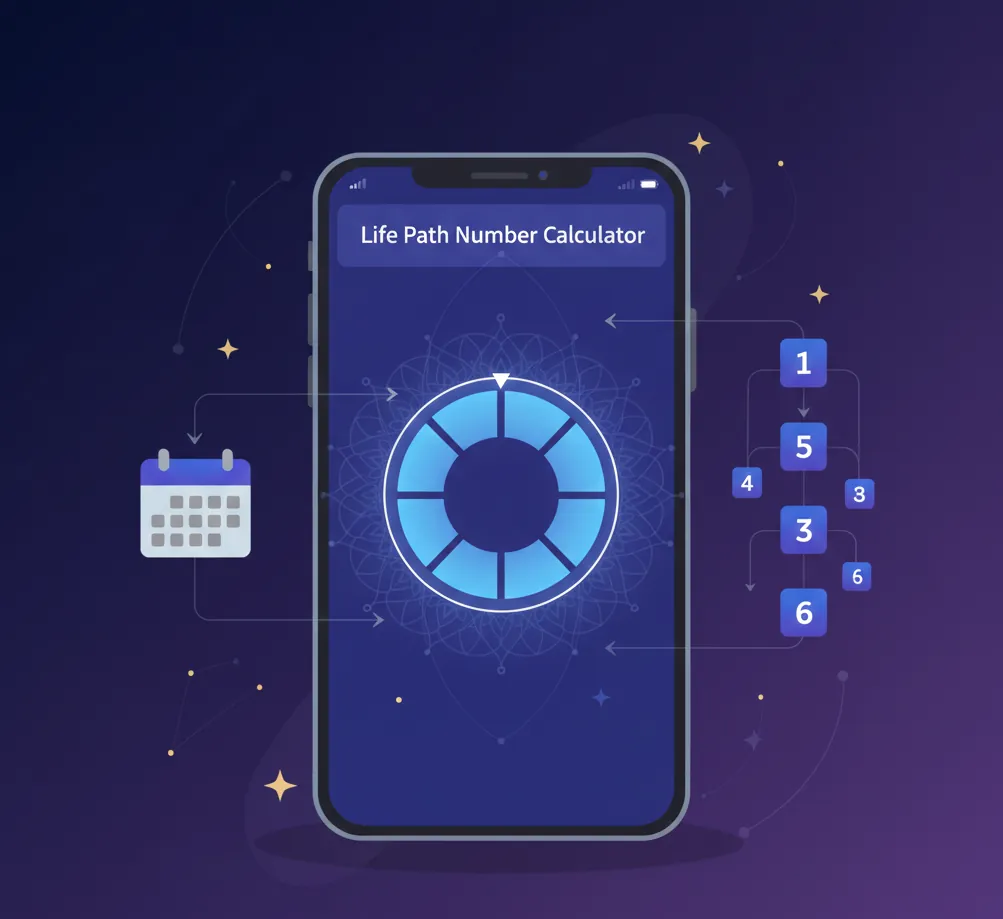
The calculation is simple and deterministic. Every digit of the full birth date (day, month, and four-digit year) is added together, and the resulting sum is reduced by adding its digits until a single digit — or the master numbers 11, 22, or 33 — remains.
Example: Birth date 15 June 1990. Day: 1+5=6. Month: 6. Year: 1+9+9+0=19, then 1+9=10, then 1+0=1. Life path: 6+6+1=13, then 1+3=4. Life path number = 4. The calculation is the same for any birth date, producing one of 9 single-digit results or the three master numbers. The numerical reduction ensures everyone's birth date maps to a small set of categories rather than producing unique individual outputs.
What Each Life Path Number Represents
Life Path 1: Associated with leadership, independence, and strong ambition. The archetypal pioneer or innovator who forges their own path. Can manifest as self-reliance or isolation depending on development. Life Path 2: Cooperation, sensitivity, and partnership. Associated with mediation, diplomacy, and attention to others' needs. Life Path 3: Creative expression, communication, and social engagement. The communicator, artist, or entertainer. Life Path 4: Structure, discipline, and methodical effort. The builder — someone who creates lasting things through sustained hard work. Life Path 5: Freedom, change, and adaptability. Associated with curiosity, travel, and varied experience. Life Path 6: Service, responsibility, and nurturing. The caregiver, typically oriented toward family and community contributions. Life Path 7: Analysis, introspection, and the search for deeper understanding. The researcher, philosopher, or seeker. Life Path 8: Material achievement, authority, and executive capability. Associated with financial acumen and power. Life Path 9: Humanitarian impulse, idealism, and universality. The visionary concerned with the larger good. Master Numbers 11, 22, 33 are considered amplified versions of 2, 4, and 6 respectively, with additional themes of spiritual sensitivity, master building, and compassionate teaching.
The Barnum Effect and Self-Reflection
Psychologists studying personality assessment have repeatedly documented the Barnum effect (also called the Forer effect): the tendency for people to accept vague, broadly applicable personality descriptions as specifically accurate for themselves. This applies directly to numerology and astrology descriptions. When you read your life path number description, the elements that resonate will feel personally accurate — and they may genuinely point to real traits — but they are broad enough to resonate with a large proportion of any population.
This observation is not a reason to dismiss the reflective value of numerology. Accurate self-description and generalizable description are not mutually exclusive. If the Life Path 7 description resonates deeply with your experience of yourself as an analytical, introspective person who values understanding for its own sake, that resonance may reflect genuine self-knowledge — activated by the reading — regardless of whether the number caused it or simply prompted it.
The most productive engagement with life path number content is precisely that: using it as a reflection prompt. Which themes resonate? Why? What examples from your own experience come to mind? That thinking — not the number itself — is the source of insight.
Numerology is a symbolic and reflective tradition, not a scientific personality system. No empirical evidence validates numerology as predictive of personality, talent, or life outcomes. Use as a personal reflection tool, not as guidance for significant decisions.