Vedic Astrology Needs Exact Inputs
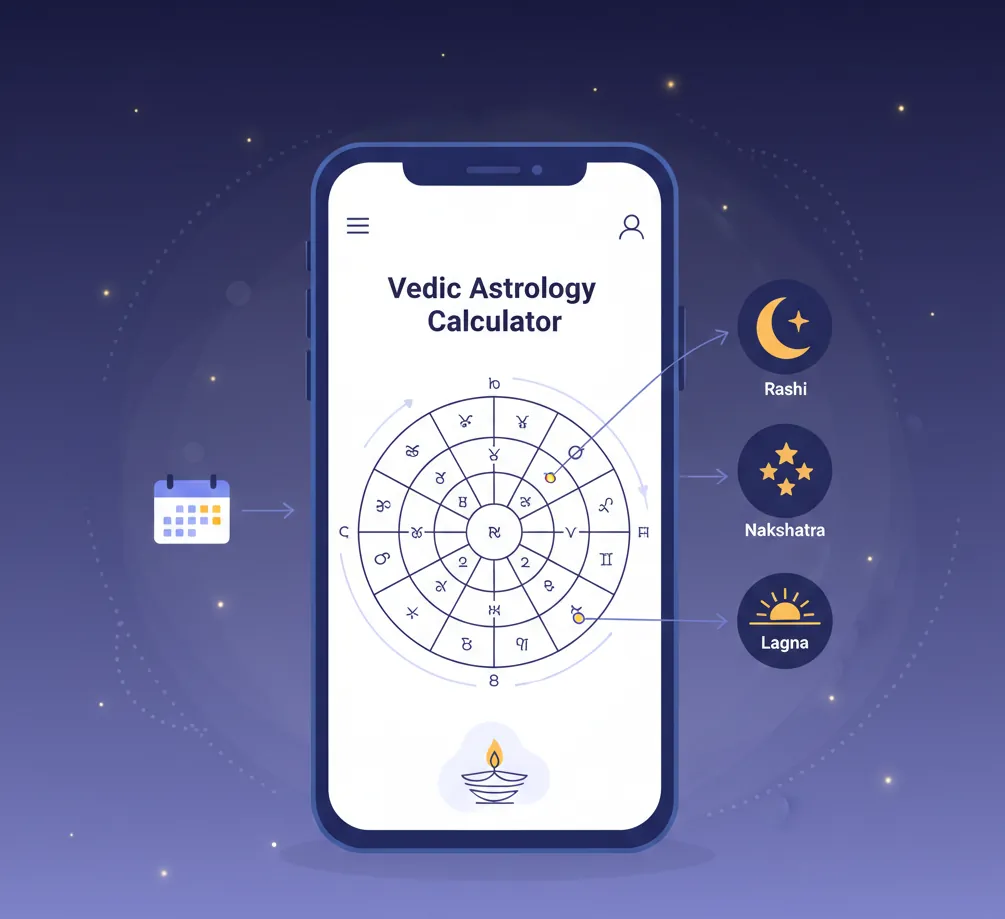
Vedic astrology is more detailed than a broad sun-sign description. Rashi, nakshatra, lagna, and planetary positions can change with birth time and place. That is why a casual estimate should be treated differently from a proper chart.
A Nashik Newborn Chart Needed More Precision
A family in Nashik checks a quick Vedic astrology calculator for a newborn and shares the rashi in a WhatsApp group. Later, the priest asks for exact birth time and location to prepare the janam kundli. The quick result was useful for curiosity, but formal rituals need more precise calculation.
Why Date Alone Is Often Too Rough
Users enter only date of birth and expect a complete Vedic chart. Date can help with broad estimates, but lagna and some placements depend heavily on time and place.
Another mistake is treating every online interpretation as equal. Traditional Jyotish has methods, assumptions, and variations. A short automated result is not a full reading.
Separate Curiosity From Formal Jyotish Use
Use quick calculators to learn terminology and start understanding your profile. For marriage matching, naming ceremonies, or major family rituals, use exact data and a qualified practitioner if the tradition matters to you.
Keep the distinction clear: curiosity tool, cultural reference, and formal consultation are different uses.
When a Quick Result Is Enough
Use this calculator when you want a private first look at rashi, nakshatra, or related concepts. Do not use a rough result for formal decisions where your family expects exact Vedic calculation.
Vedic Reference Tools
The Final Takeaway
Precision in birth details determines the accuracy of a Vedic chart.
Suggested Action
Verify your exact birth time from official records before consulting a professional astrologer.
Jyotish: India's Living Astrological Tradition
Vedic astrology — known in Sanskrit as Jyotish, meaning "light" or "science of light" — is one of the six Vedangas (auxiliary disciplines of the Vedas) and one of the oldest continuously practiced astrological traditions in the world. Unlike Western astrology, which has been largely secularized and popular-culture-ified into sun-sign horoscopes, Jyotish remains deeply embedded in Indian family life — consulted for marriage compatibility, naming children, selecting auspicious dates for ceremonies, and in some communities, for major decisions around business, travel, and relocation.
For modern urban Indians who may not have grown up with detailed Jyotish practice, encountering references to "your rashi" or "your nakshatra" can be confusing without any foundational context. This guide provides that context in accessible language, explaining what the main components of a Vedic birth chart mean — not as belief-enforcement, but as cultural literacy.
The Three Key Components of a Vedic Birth Chart
Rashi (Moon Sign): In Jyotish, the rashi — the zodiac sign the moon occupied at the moment of birth — is the primary identifier, more significant than the sun sign used in Western astrology. The moon sign is used for kundali matching, daily panchanga reading, and muhurta selection. There are 12 rashis, each spanning 30 degrees of the sidereal zodiac: Mesha (Aries), Vrishabha (Taurus), Mithuna (Gemini), Karka (Cancer), Simha (Leo), Kanya (Virgo), Tula (Libra), Vrischika (Scorpio), Dhanu (Sagittarius), Makara (Capricorn), Kumbha (Aquarius), Meena (Pisces).
Nakshatra (Lunar Mansion): The 27 nakshatras are equal subdivisions of the 360-degree zodiac, each spanning 13°20'. The nakshatra the moon occupies at birth is even more specific than rashi and carries interpretive significance in Jyotish. Each nakshatra has associated planetary lords, deity, symbolic qualities, and syllable groups used in Vedic naming conventions. Nakshatras are also central to transit analysis (gochara) in Jyotish practice.
Lagna (Ascendant): The lagna is the zodiac sign rising on the eastern horizon at the precise moment and location of birth. It changes approximately every 2 hours as the Earth rotates, which is why accurate birth time is critical in Vedic chart calculation. The lagna determines the house system — the 12 houses of the chart that govern different life domains: self, wealth, siblings, home, children, health, partnerships, longevity, dharma, career, social circle, and liberation. Without accurate birth time, the lagna and house-based analysis cannot be reliably determined.
The Ayanamsha: Why Vedic Zodiac Differs from Western
The key technical distinction between Vedic and Western astrology is the zodiac reference system. Western astrology uses the tropical zodiac — anchored to the vernal equinox and seasonal reference. Vedic astrology uses the sidereal zodiac — referenced to the actual positions of stars as they exist in the sky now.
Due to precession of the equinoxes (Earth's axial wobble over roughly 26,000 years), these two zodiacs have diverged by approximately 23°15' to 23°50' (varying by ayanamsha system used). In practical terms: planetary signs in a Vedic chart are about 23 degrees behind the equivalent Western position. For most people, this shifts 2-3 planetary signs by one sign compared to their Western chart — which is why your Vedic sun sign is almost certainly different from your Western sun sign, and why rashi (Vedic moon sign) differs from Western moon sign for many people.
Dasha System: Vedic Astrology's Timing Framework
One of Jyotish's distinctive contributions is the Vimshottari Dasha system — a planetary period framework that divides a lifetime into sequences governed by specific planets, each running for a defined number of years: Sun 6 years, Moon 10 years, Mars 7 years, Rahu 18 years, Jupiter 16 years, Saturn 19 years, Mercury 17 years, Ketu 7 years, Venus 20 years — 120 years total, cycling from birth based on the nakshatra occupied by the moon.
Within each major dasha (mahadasha) are sub-periods (antardasha) ruled by other planets in sequence. Jyotish practitioners use the dasha sequence combined with transit analysis to provide timing indications — when specific life events or themes are more or less prominent. This temporal dimension distinguishes Jyotish from simple sign-based astrology and is why practitioners need the full birth chart for meaningful analysis.
What a Simplified Online Vedic Tool Can Provide
Any simplified Vedic calculator, including this one, can provide orientation-level information: primary rashi, nakshatra name, associated qualities, and introductory context. This is useful as cultural literacy, as a starting point before consulting a traditional almanac (panchanga) or a Jyotish practitioner, and for understanding references made by family members in cultural contexts.
A full Vedic chart reading requires birth time accurate to the minute and birth location. Without these, the lagna (crucial for house analysis), pada (nakshatra quarter), and precise dasha start date cannot be reliably determined. For ceremonially significant consultations — kundali matching, muhurta selection, annual jataka reading — a qualified Jyotishi with full chart calculation capabilities should be consulted.
This content is for cultural information and educational interest. Vedic astrology is a living traditional knowledge system with deep cultural significance in India. Any significant decisions regarding marriage, health, financial matters, or life planning should be made based on practical evaluation and qualified professional guidance, not astrological inference alone.